
Words vs Pictures in comics
Read this short by Scott Gray (with an assist from the KING!)

Last week we explored how even a wordless comics panel can convey multitudes.
Now, in issue #4 of Making Comics (which you’re currently reading!), we’re going to get into just how easy it is to ruin all them pretty pictures by stamping useless words all over ‘em. But fear not, comics people, because we’ll also share some insights into how words and pictures can team up and transform into a dynamic duo as powerful as peanut butter and jelly.
Case in point…
Here’s a complete short story by Scott Gray below. It’s a special one, especially for fans of Jack Kirby.
The following is a story featuring art, lettering, layout and composition all by Mr. Gray. The words are from the man himself, Jack (The King) Kirby, as he relays a story from his time serving in WWII.
Now for those who may not know, Kirby is a titan of American superhero comics and THE titan of comics artists. When the ‘which artists would be on the Mount Rushmore of comics?’ debate rolls around, Jack Kirby is the given first slot before the actual debate even begins. His first round status would be cemented even if his creative output had simply fallen from the sky with his name stamped on it. But alas, the man himself lived a titan-worthy life that adds much to his legend.
That’s why I’m particularly excited to share Scott’s 5 page comic (you can access via this link or click the image below). Give it a read, as it’ll feed directly into today’s subject:


How ‘bout that?
I was stunned by this story the first time Scott shared it with me. Honestly, I’m even more taken aback by it after having more time to reflect. I was not aware of this tale prior to reading this short. What I DID know was the fact that Jack Kirby had seen combat in the war. He led missions into enemy territory, literally sketching out Nazi-controlled territories AHEAD of advancing US troops. But this wasn’t the FIRST righteous charge he led in the war effort. Nope. Long before he stepped foot into German-occupied France, Kirby led the fight against the nazis with a pen and paper.
Kirby and writer Joe Simon co-created Captain America well before the US was formally at war with Germany. These creators, both of them 2nd generation Jewish immigrants, were in effect actively rallying up the youth of America, and notably the gentiles among them.
The blond-haired blue-eyed Steve Rogers, and EVERY facet of the Captain America character’s patriotic iconography was all in an effort to encourage those who needed the push. Make no mistake, this book was propaganda. Kirby and Simon were rallying the Nazi’s own target audience to fight the good fight, to let them see a bit of themselves in this effort, to encourage them to want to stand up for those who were truly vulnerable and in immediate harms’ way. They were inviting young Americans to dream about defeating Nazis. It was DAMN GOOD propaganda. As the late congressman John Lewis would have called it, Kirby and Simon were causing GOOD TROUBLE.
Kirby famously debuted Captain America with a cover image which famously featured the character punching Adolf Hitler in the face. This was provocative stuff in a pre-war America that was home to millions who actively sought to emulate Nazi policies stateside. Indeed, the provocation was such that the mayor of NYC even had to call in extra security for Simon and Kirby when American Nazi sympathizers tried to pick a fight with the King, inviting him down to the street for a fight. By several accounts, Jack had rolled up his sleeves and came down to meet them. But they were no shows.
This is all to say that Jack Kirby had a fighting spirit, which makes the lived-in anti war parable as realized in this short comic all the more profound for this reader. Artist Scott Gray captures this weight elegantly. Take note of the use of negative space, the white on black and vice versa, and how the lettering and composition directs your eye, reinforcing both the setting as well as the emotion-conveyed in this relayed event.


With a deft hand like Scott’s (and with an assist from no less than the King himself), that’s some peanut butter jelly time right there.
What say you?
I’d call this a fitting story to showcase as we introduce the concept of ‘letters’ into our discussion about comics. Combining words and pictures ain’t all bad. Clearly. MOST comics mix ‘em up, and MANY (like Scott’s) are able to strike that smooth balance.

From Scott McCloud’s ‘Understanding Comics
I write comics myself, and perhaps it’s a bit ironic that we’re only just now beginning to consider the words that sometimes get sprinkled all over these things. In issue #3 we emphasized the extent to which the art is the propulsive engine for any comic. But I’ll admit this emphasise was at least in part for dramatic effect…
The truth? The truth is that words DO matter in comics.
Dun dun dun!!!
But all that earlier emphasis on deferring to the visual storytelling wasn’t without cause. Because I promise you, each word will accomplish so much more if they’re chosen in deference to the imagery.
Readers will experience how words matter in comics. You can feel it every time a comic just doesn’t quite flow, or worse yet, when you find yourself literally skipping some of the text. It’s on us as writers if we never learn from these would-be lessons. Most often, the answer is find ways to reinforce the visual storytelling, or to simply take a step back. There are a million and one ways in which a single image or a page’s composition can propel a story forward more effectively than any line of dialogue, or any specific word choice.
If you’re not at least TRYING to think like a visual storyteller, you’ll miss out on millions of opportunities for more effectively expressed storytelling. Fail in inhabiting this mindset and more mistakes will be made and lessons gone unlearned. There’s a guilty dude right here btw (I’m raising my hand). Without a clear sense of layouts or panel composition, a comics writer can and will produce words that’ll have to be crammed awkwardly, or often even needlessly, into their place. On some level, EVERY comics writer who is not themselves producing the art will fall victim to these mistakes.
But at every opportunity, TRY to think of the visual communication first. It’s easier said than done. It’s a practiced skill to harness over time.
Do you have any idea how many excellent prose authors have crashed and burned when trying their hand at comics writing?
I’ll give you a hint: it’s not just a lot of them.
It’s the vast majority.
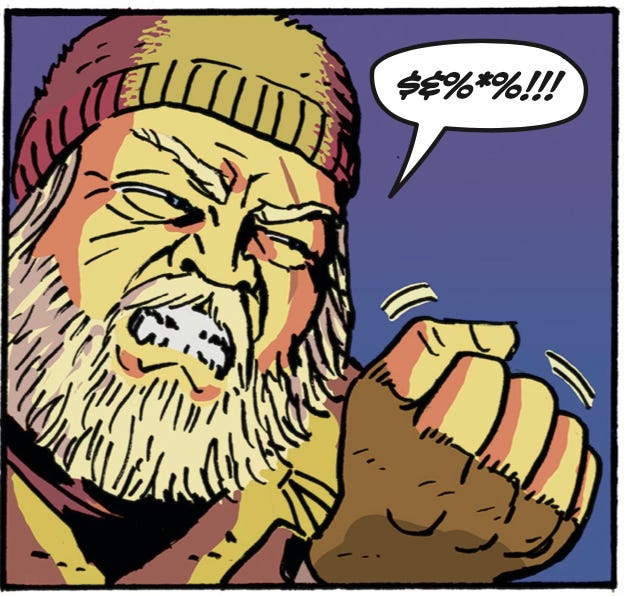
Many comic writers severely under-appreciate the extent to which their writing must be in support of (and in deference to) the visual storytelling on the page. This level of deference requires restraint, understanding and tremendous patience. A comics writer needs to be prepared to learn from each individual artist, each new page, each new panel.
Okay. Now jut allow me to stress (and maybe even intentionally OVER-EMPHASIZE) one more thing, especially for the comics writers out there:
Before anyone will read all those words you’ve been stressing over, everything on the page has to be eye-catching, even the letters themselves…
More on this next week.
To close things out for today, I’ll point out that it’s no wonder that most of the best comics creators do it all. The output from the writer / artists who create complete, holistic visions all by their lonesome takes up a sizable portion of the very best of the medium. THIS fact isn’t so ironic. At least, it really shouldn’t be.
Artists tend to naturally defer to the visual storytelling. They're just more likely to think visually. All the better if they’re also the writer. But fortunately for us comics writers, there are some kind artists out there who will share the thrill of creation with us. The least writers can do is to bow down in gratitude and write FOR them.
Now, what was that first line again??
Next week, we’ll return at our regularly scheduled time (Fridays) and tackle the subject teased in bold a few paragraphs back. But here’s a taster. The title for next week’s post will be:
Letters in action!
For now, thus ends another issue of…

I’ll be thinking of ya in Baltimore, Jack…
