
How to pitch a comic series
I've got one successful example to share

Couple years back I had a comics pitch. It was solid. Solid enough, apparently, to open the door to contract negotiations with two mid-sized comic publishers (details in this post). In this post, I’m gonna share that pitch with you fine comics people!
My experience with comics pitches is limited. But I figure seeing a full ‘successful’ pitch might be a helpful resource. There’s one thing I want to be sure to point out first though: different publishers have their own pitch / submission guidelines. Make sure you adhere to their specific stipulations. You heard? Lucky for us, there is often a lot of overlap in these ground rules, and that area of overlap is where we’re focused in this post.
So here it is, the pitch for Wild Wes, written by myself with art / colors by Nate Walkington, lettering by Es Kay and Jon Westhoff and cover art by Scott Gray:
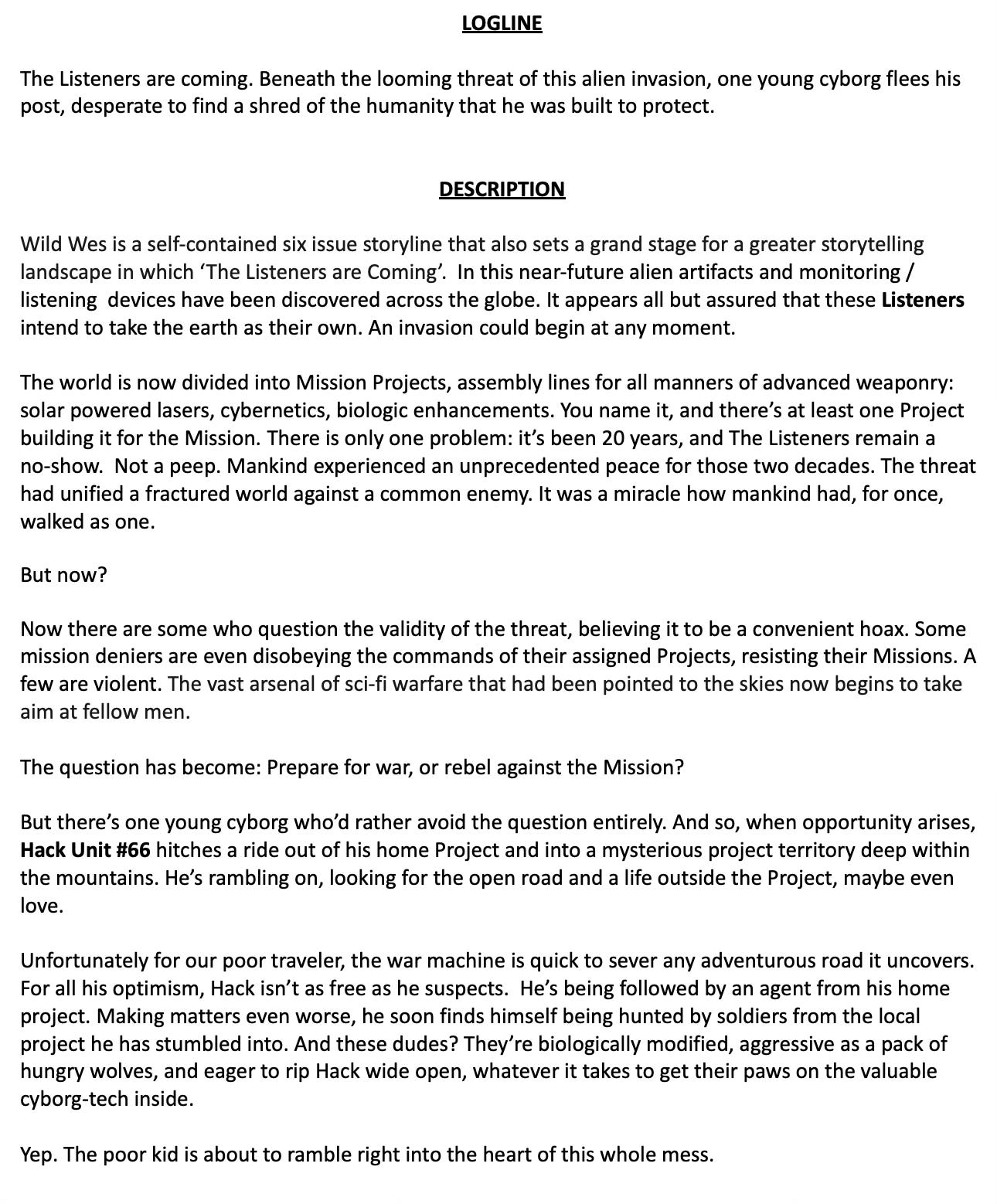
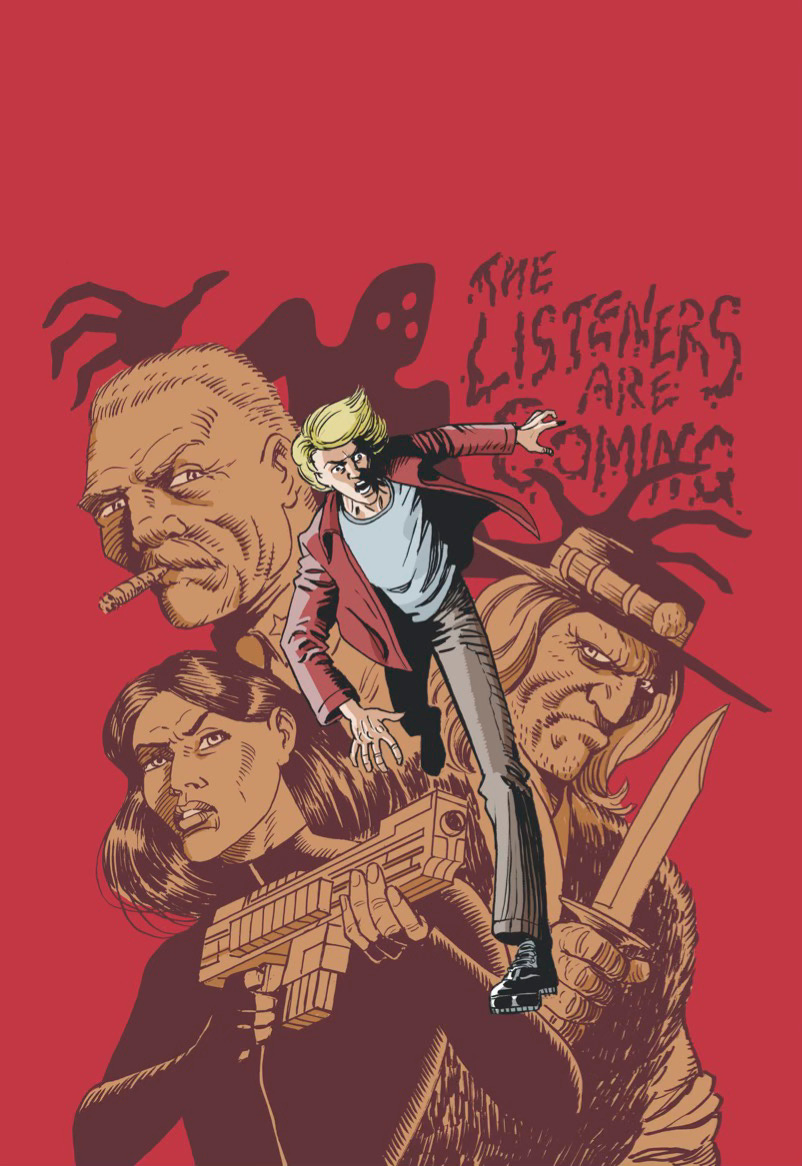
Naturally, in re-reading the pitch there are a few things I feel compelled to edit. Because I’m incapable of revisiting any piece of my own writing without feeling that pull to edit or rewrite it… Alas, what you see up top is exactly what the would-be publishers received.
Some publishers do also request a full story outline / synopsis. I wrote an outline for Wild Wes as well, but sadly will not be sharing that with you fine comics people today. I don’t want to share the full plot, because I still have a desire to complete this comic someday if fate allows. But honestly, in terms of creating interest, a full series outline is a distant third after a (1) strong logline / description and (2) actual completed pages.
I’ll share a bit more about Wild Wes after the jump, including some important elements that were NOT in the that document. First, let’s consider what you see in this pitch…
Note the two key elements in this one single-page document:
Logline
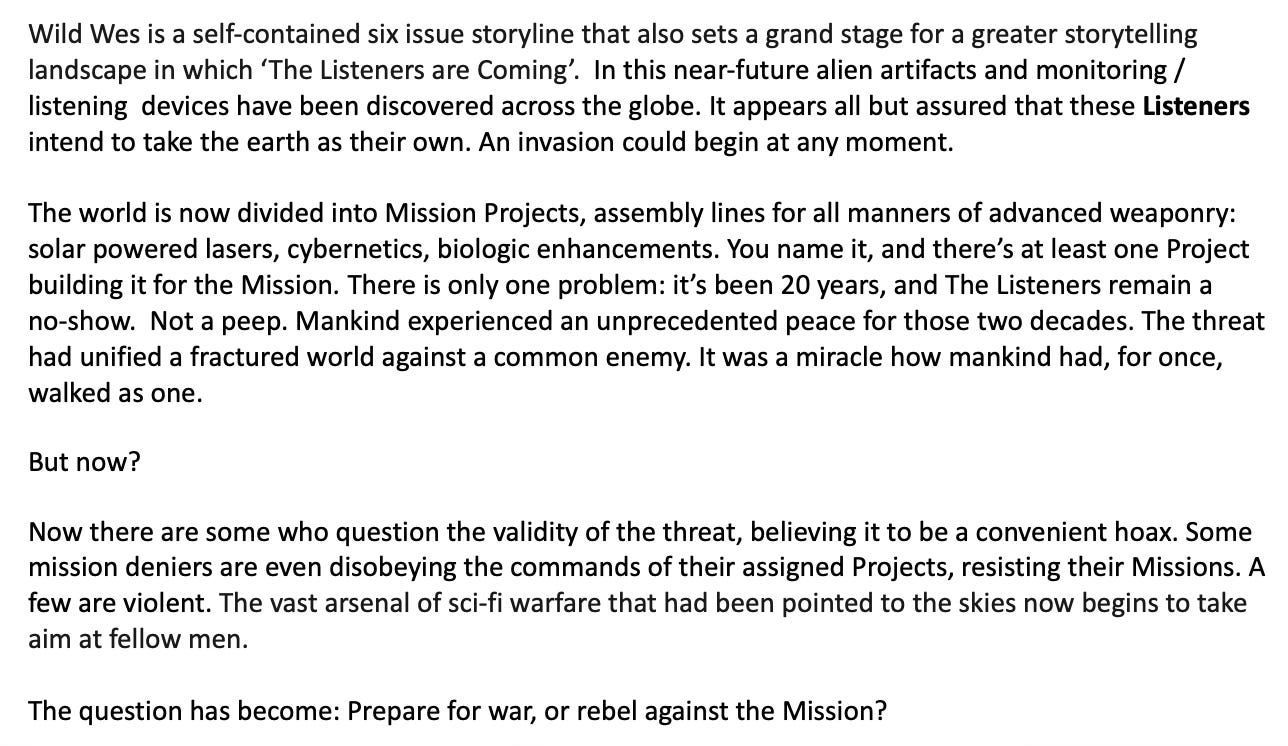
Description
These two elements work together. They’re basically both elevator pitches for your story. A ‘logline’ is for a particularly short elevator ride from the lobby only up to the first floor, so we’re talking a sentence or two at max. Whereas a ‘description’ is also a means to layout your story’s hook and create interest, but can be up to a page long and paint more of a holistic picture. Basically, the description section is an elevator ride from the lobby all the way up to the penthouse, but it’s only one elevator ride all the same. So make every word count!
Take a Quick Look back at the Logline / Description above. You’ll see that, even taken together, they both fit onto one page comfortably. There’s room to spare. It’s a somewhat inviting read. Locking this down to one page was something I struggled with, as my first instinct was to write a cluttered and lengthy outline. Working with such limited space is damn tricky, especially for a writer whose instinct is to write… potentially quite a lot. But that’s not what’s being asked for with these pitch elements; it’s a test of your storytelling economy.
Try to think of these pitch sections as a trailer for your story. Do enticing trailers serve up the exact sequential events of a tale, or meticulously introduce characters? No. They’ll share some plot beats, and we’ll see some characterization, but only as table setting for positing some interesting questions re: how your character(s) might need to respond to the fascinating drama in which they take part.
Your key focus with the logline and story description is to try and answer the question: ‘why should I, a potential reader, be interested in this story?’
In the case of Wild Wes, my answer to this question was at least somewhat successful (I think) because I laid out an interesting environment and threat (#1), introduced a motivated and empathetic target of this threat (#2), and gave us a heck of a knot / cliffhanger to consider (#3). Boom. Bang. Boom.
BOOM
BANG

BOOM
If you’re considering pitching your own comic, I hope that this post and shared example help you better prepare for your Making Comics journey. Make each pitch your own, something singular and linked to the nature of your story(ies).
Case in point, the Wild Wes pitch is pretty light on character(s). Instead, it’s quite focused on the world and environment. But to make up for this, we put together some character intros in our pitch (which we never used). Instead, we had something even better, we had the completed opening pages to the book. And the story itself, especially these opening pages, were quite character centric. So the purely prose elements of our pitch deck compensated a bit with a strong focus on the threat and landscape through which they operate. Pieces of the puzzle working together.
Here are some of Nate’s character pieces, for reference:


We figured these character designs would double as rad pin ups for a completed issue #1’s backmatter ( 75% of the first issue is complete. Check out below!). Always hold on to your sketches, character design and process pieces, comic people. They might prove useful down the line!
There are a number of questions that have stuck with me about Wild Wes…
Could the threat of an alien invasion unite a fractured humanity?
It’s a sci-fi AF conversation starter.
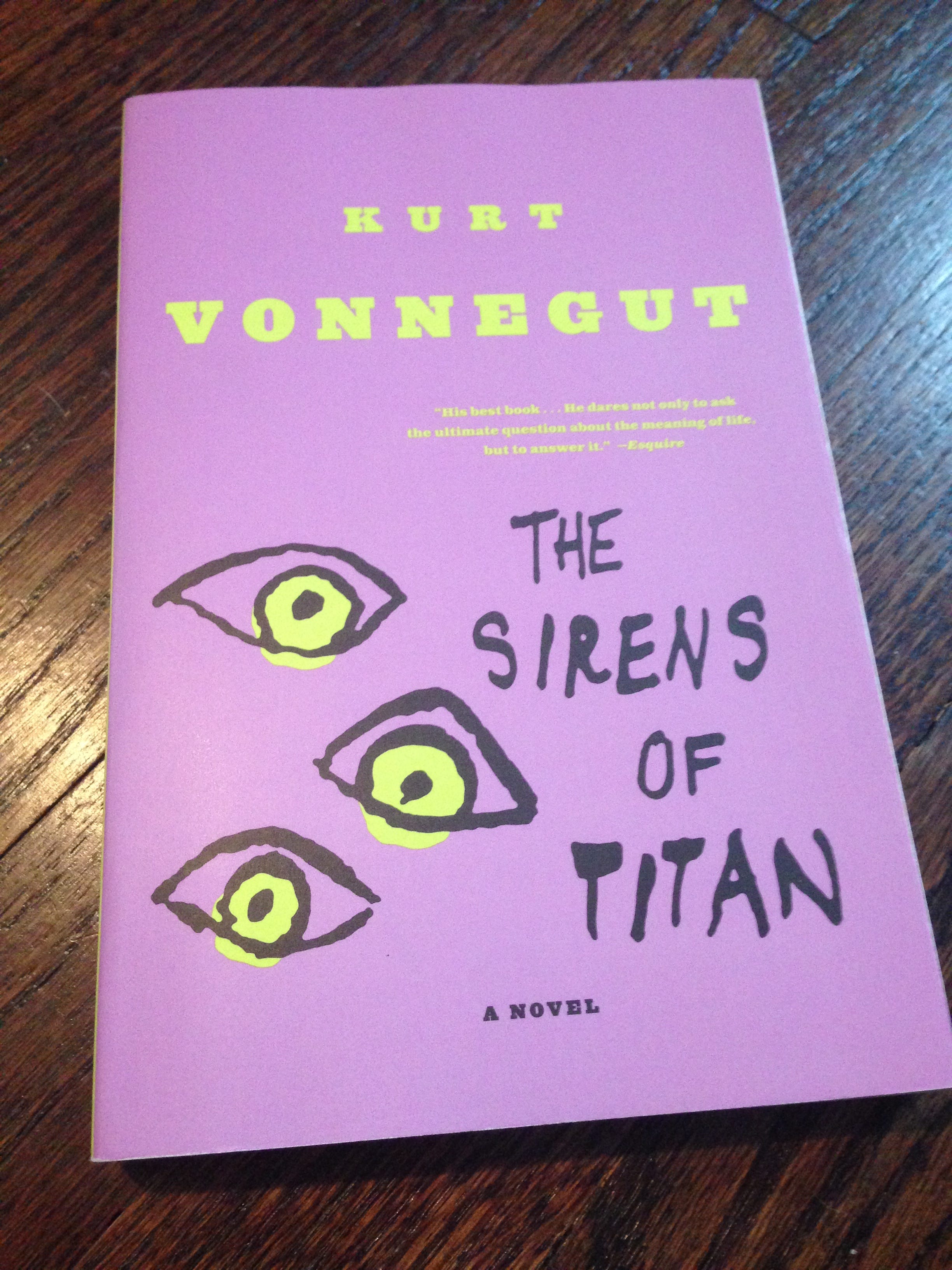
Wild Wes presented a lived-in answer to this question. And indeed, it’s a question that’s fun to explore. Not an altogether original one though. It’s been explored in some particularly notable fiction already. The two most famous examples might be Kurt Vonnegut’s The Sirens of Titan, which was an exceptional satire exploring (among other things) the concept of ending man-made mutually assured destruction via a manufactured invasion. A couple decades later, on the comics front, Alan Moore’s Watchmen considered that same possibility from its own angle, diving into such a situation’s moral quagmires. In both of these works, it’s a concept that is immediately understood for its likelihood in reshaping mankind and global geopolitics. But how, exactly, might this affect people’s day-to-day? How might it affect our aspirations or stifle our freedom?
The unique wrinkle found in Wild Wes was its shape as a western of sorts, and in capturing a flavor of that genre. It’s baked right into the series’ title (though there’s also an extra layer to it I won’t be spoiler here). ‘Wild Wes’ has an element of corniness too it, I’ll admit. But the title strikes at that spirit of wanting an escape to some mythical / unknown ( unknown to us!) corner, someplace away from the harshly rigid expectations of all-too defined society… while also exploring the longer-term look at how a (potentially!) manufactured alien threat might play out decades after the fact.
‘The Listeners are Coming’ is another title we considered. We also played around with ‘Prisoners of War’, as a title that hit more squarely on our duty-bound characters, folks who are existing in a world that’s utterly locked into its global-in-scale military industrial complex. Could this kind of build-up be maintained if this alien enemy remained a no-show for 20 years?
It’s impossible to know exactly how such an insanely heightened situation might unfold. Perhaps given enough time, it might make a life free from the war effort damn near impossible… as well as irresistibly enticing. It’s reasonable to assume that we’d yearn for the natural world. A day at the river, or a hike though the mountains would be all the sweeter. I think that the call of the wild would be strong indeed… shame that title was already taken!
A title is a fundamental cornerstone for a pitch. It’s also just fun to invent titles that reinforce something about a story. I mean… a title can help tie the whole room together, man.
Wild Wes was meant to help fire off some synapses into the right directions. The logo (by Don Cardenas) is also meant to guide you onto our road. A title (and logo) can serve to define some perimeters that can help ease a reader in… though ultimately, if Nate and I were doing our job right, we’ll zig around some of your expected zags.
I mean, heck, maybe The Listeners were really coming after all? In which case, would Hack Unit #66’s wanderlust be a siren best left unheard?
I’d like to think these questions might get some gears turning. But these questions weren’t in my actual pitch. Our actual pitch began with exactly what was shared above.
And if you want to read WILD WES, I have some good (and some bad!) news…
If you’re interested in Wild Wes, you can read the (nearly complete) first issue below!
I’m bummed that this story never saw the light of day. Until today, I’ve literally only ever shared it with collaborators and would-be publishers. But for you fine comics people, I’m sharing our WIP first issue!!
The issue isn’t complete. Hence the ‘Work in Progress (‘WIP’) disclaimer. But it’s more than 75% of the way there…
Perhaps we could finish this thing someday. Any eccentric comic financiers out there??
Don’t worry, I still think you’re cool, even if you’re not a silly wealthy patron of the arts. So this one’s on me. I’ve set up these first 22 pages of Wild Wes #1 as 100% free to read.
Take a journey into the world of WILD WES and simply let me know if you’d like to see more. Click right here (or on the title image below) to dive right into the ride:

Normally this is where I’d say ‘something, something… MAKING COMICS’.
But why are you still reading?
Click on the link directly above and check out WILD WES #1!
But, I mean, YES, you should probably be…
Thanks for sharing. It’s always great to see how other creators pitch and think about the process!