Throw Rocks at Your Comic
When crafting a story, always keep a pile of rocks handy

Hey Comics People,
Welcome to issue #7 of Making Comics, a place where we dive into the craft of… Making comics.
Is this not obvious yet?
Imma start this post by sharing a secret about me: I’ve got a TON to learn about storytelling. Making matters worse, I’m a slow learner. Slow and steady? Sure. But slow all the same. Making Comics is a place to share insights and to inspire, and nothing would please me more than if these posts could serve to put a bit of extra fuel in your tank. But I can tell you for sure that the creation of this blog is a helpful exercise for this writer, as it’s an opportunity to reflect and reinforce the learning process. Maybe some extra reflection will even help a dude avoid stepping on some of the storytelling rakes he’s ALREADY stepped on a few times…
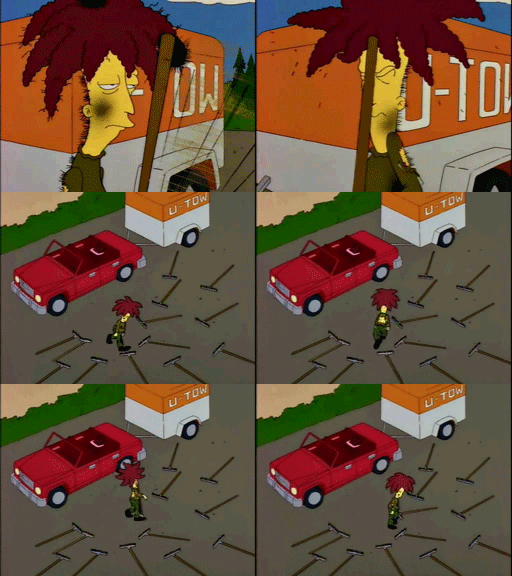
Fortunately, I’ve found a few tools along the way that have helped me a ton. Including some tests to assess and improve stories as I write them… They might help you too.
So grab your #2 pencils. Because in this post I’ll be sharing three of these tests!
Okay. Calm down. You can just as easily think of these as three easy-to-apply hacks for assessing and improving your stories. They’re real ones this time by the way, unlike last week, which I’ll admit now was more trick than treat…
These are tools to add to your comics making workbench. They could also be applied to prose or film. But in comics, forward momentum (and ‘movement’ in general) is that much more important a consideration, so these are assessment devices designed with movement / momentum in mind. These can be used at any stage of your creation journey, whether you’ve yet to commit a single word to writing, or if you’re deep into your millionth re-write. They’ll help to overcome our paralysis when we begin second guessing our story, and to help ensure they’ve got some real dramatic juice to keep would-be readers engaged.
If you want to skip ahead, these three tricks are listed below. But if you’re one of the cool kids? Shoot. Why not linger here a bit and let’s wax poetic all the way down the line. I mean, we’re all here to learn together and to fall into the process a bit. So… let’s.
For those who haven’t checked out the first few Making Comics posts, or even for those who might want a recap: in issue #2 we explored the question ‘why write comics’. One of our answers was that making comics presents an ocean of possibility, and that it’s in our nature to want to dive into those waters. It’s human to sit around the campfire and try to make sense of it all. This ocean is our analogy for where we go to find the stories. That mysterious creative zone is as nebulous as life gets. As such, an analogy is appropriate, and an ‘ocean’ is appropriately vast in both width and depth, its mysterious, dangerous and kinda intimidating, so let’s run with it.
We’ve all got a bit of gravity compelling us to cast a line down into those waters. Some just can’t resist it. Choose not to even.

Fishing for story ideas is well and good. But what, exactly, do we pull up? And what do we do with our bounty? The reality is that fishing can be a lot more appealing than filleting and cleaning our catch… Heck, have we even caught something that’s edible, or are we confident that we can cook it properly?
In storytelling, many of us become catch & release fisherman, because the act of conceiving stories is often the most fun part of the process. The next bits are laborious and is where you can risk ruining the whole meal. Sharing our cooking is also a scary prospect, as with anything that carries a risk of ridicule. I’m getting anxious just thinking about it. So let's stop thinking of our stories as fish or anything that is to be consumed for that matter. Indeed, that’s a limiting perspective. The reality is that you can find anything down there.
Sometimes whatever we pull up turns into nothing but loose sand that’ll spill through our fingers once that handful is brought up to the surface, like we’re panning for gold in pure silt. Other times, some firm fragments will remain in our grasp. Little bits, like maybe some characters, concepts, or tones.

This is all good stuff. But ideas are cheap. It’s a hard pill to swallow. So take some heart in the fact that ideas being cheap doesn’t mean that dedicating time for discovering them isn’t a feat in and of itself. Just don’t congratulate yourself too much for grabbing a few ideas. This is a first step, not an entire process.
Conversely, if you’re concerned that ALL YOU HAVE is a few ideas, and that you don’t yet have ALL the pieces for your magnum opus? Cool. You have some ideas to work with.
Start putting those pieces together and you’ll discover the rest along the way. Don’t wait to get started until some magical moment when it’s all fully formed in your head. That’s never gonna happen.
There’s a paralysis that can come with creating your ultimate dream story. I’m gonna dub this ‘The Magnum Opus Complex’, it’s when would-be storytellers refuse to get started in the serious work of crafting their story until they’ve fully cracked some mysterious grand design. I believe that some degree of this complex prevents more stories from getting made than just about anything else.
The reality is that your story isn’t going to be perfect, and even less so if you don’t get into the groove of actually finishing some imperfect stories. So… just dive in and take what you can get bit by bit. Lay some foundation, get some framework going, but don’t live in the construction site for months or even years on end. Because guess what? In storytelling you can (literally!) make the rest up as you go along. So get moving already.
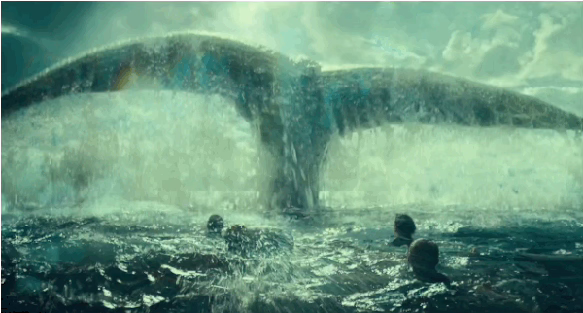
I mean, chasing ‘The White Whale’ is a trap after all…
Isn’t it?
I’m seriously asking by the way. I’ve never been called Ishmael and I have never read Moby Dick. But I HAVE been running with The White Whale as a cautionary metaphor for a long-ass time now.
Anyways…
When we begin piecing together a tale we often begin with broad strokes, characters, settings, key-dramatic-happenings and such. In some cases, you may even have certain scenes or even pieces of dialogue you're keen to build around. Whatever the case might be, sooner or later (and sooner is always better), we should start committing some of this to writing. Because the moment we formally begin to chronicle these ideas is when we’re ‘writers’. So just BE a writer. Take that jump.
What’s the worst that could happen?
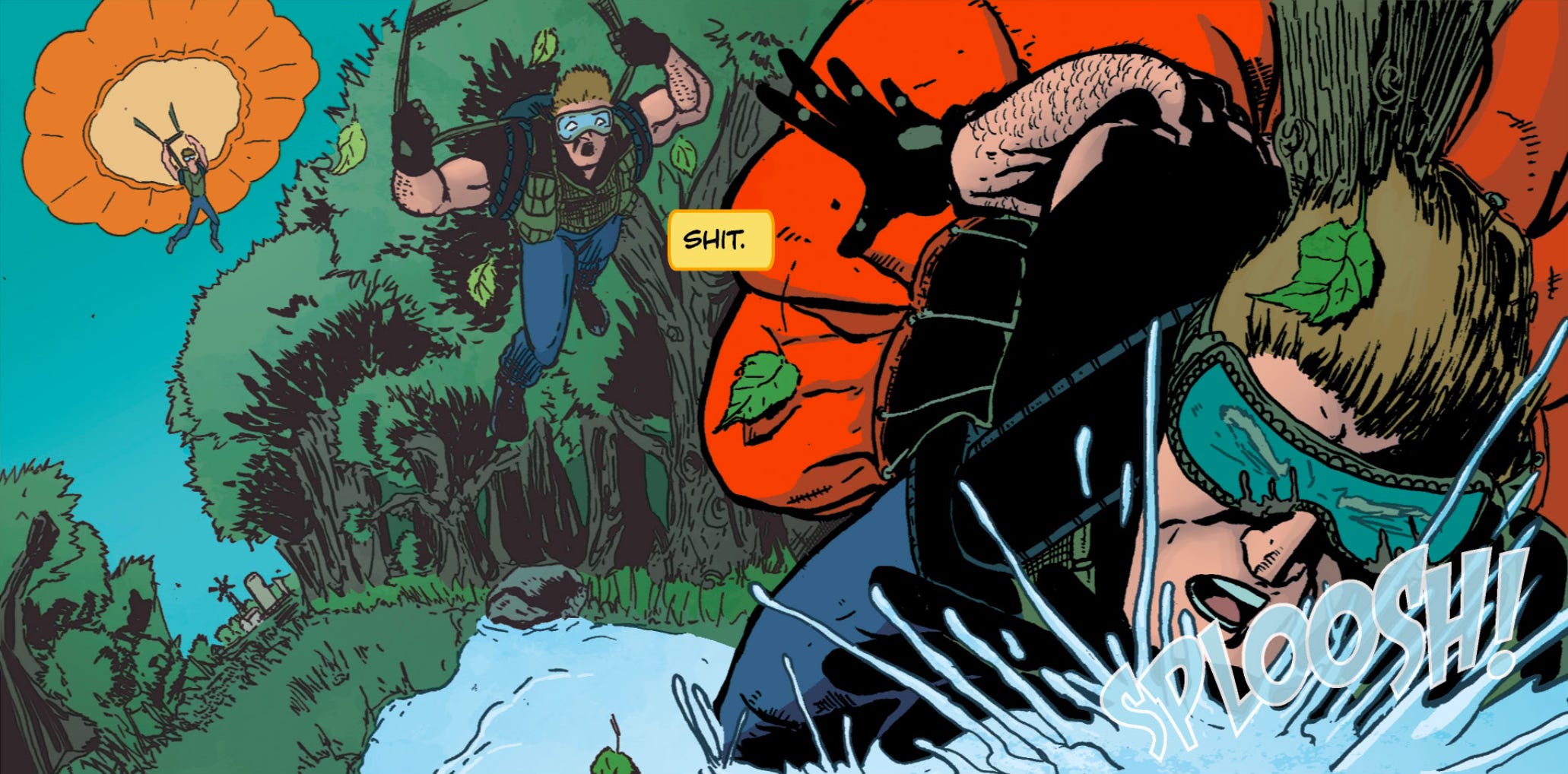
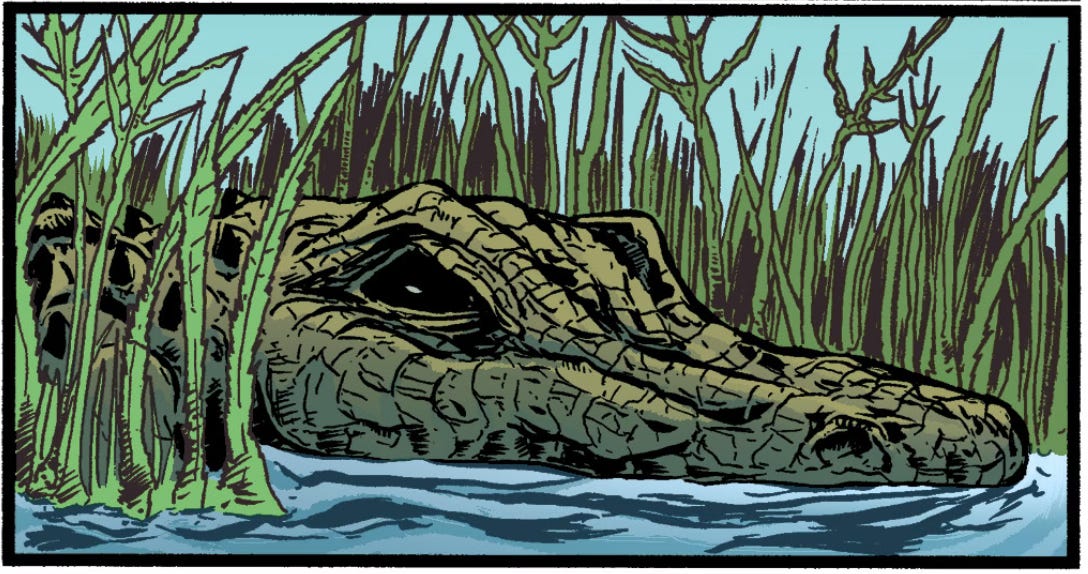
Remember: The ideas we find down in that ocean come cheap. Nothing is cheaper than ideas, however good they might seem or however precious your story idea might feel. Hey, I’m not knockin’ ‘em by the way. Maybe they’re excellent ideas with genre-defining potential. This doesn’t change the fact that sorting through and polishing them into something whole and complete is the tricky work we need to get started. That’s the valuable stuff. So dive in, scoop up as many ideas as you can find down there, then head back up to the surface and give ‘em a good look.
Your first goal in this assessment stage is to identify the ideas you’d really like to get to know a bit better. Let your own genuine interests be your muse here, rather than the pursuit of the great American nov… er, comic book. These initial little story fragments are going to become foundations for your stories. If you don’t truly love them yourself, you’ll just come resent them along the way (and you’ll be that much more likely to abandon the project rather than finishing what you started).
Once an idea for a tale exists, you’ll begin to write it all down, piece it together, maybe even write the entire thing. But wherever you are in the process, you’ll reach a point where you second guess it's structural integrity…
Which brings us (finally!) to today’s exercises that (in my experience) can help get things moving at this crucial juncture. They’ll help you most at the critical pivot points at which you might otherwise stall out. For me, it’s proven most helpful to consider these questions when faced with editing or rewriting a comics script. But it’s wise to consider them from the very beginning.
First up…
1. What does each character want?
And what stands in their way?
A story’s tension comes from forces conspiring against a desired outcome.
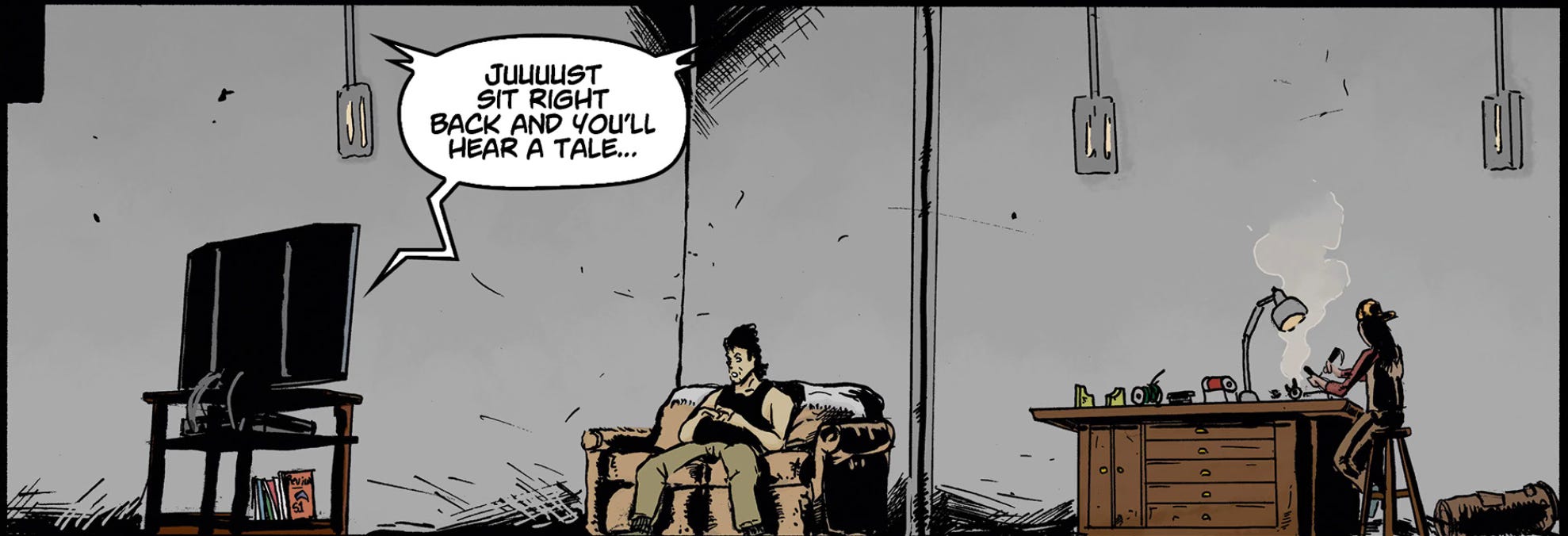
Here’s an example that was created in part from considering this very question. It’s from Big Shoulders #1. The scene features two young love birds who are desperate to remain together… and narration from a third party that suggests doom.
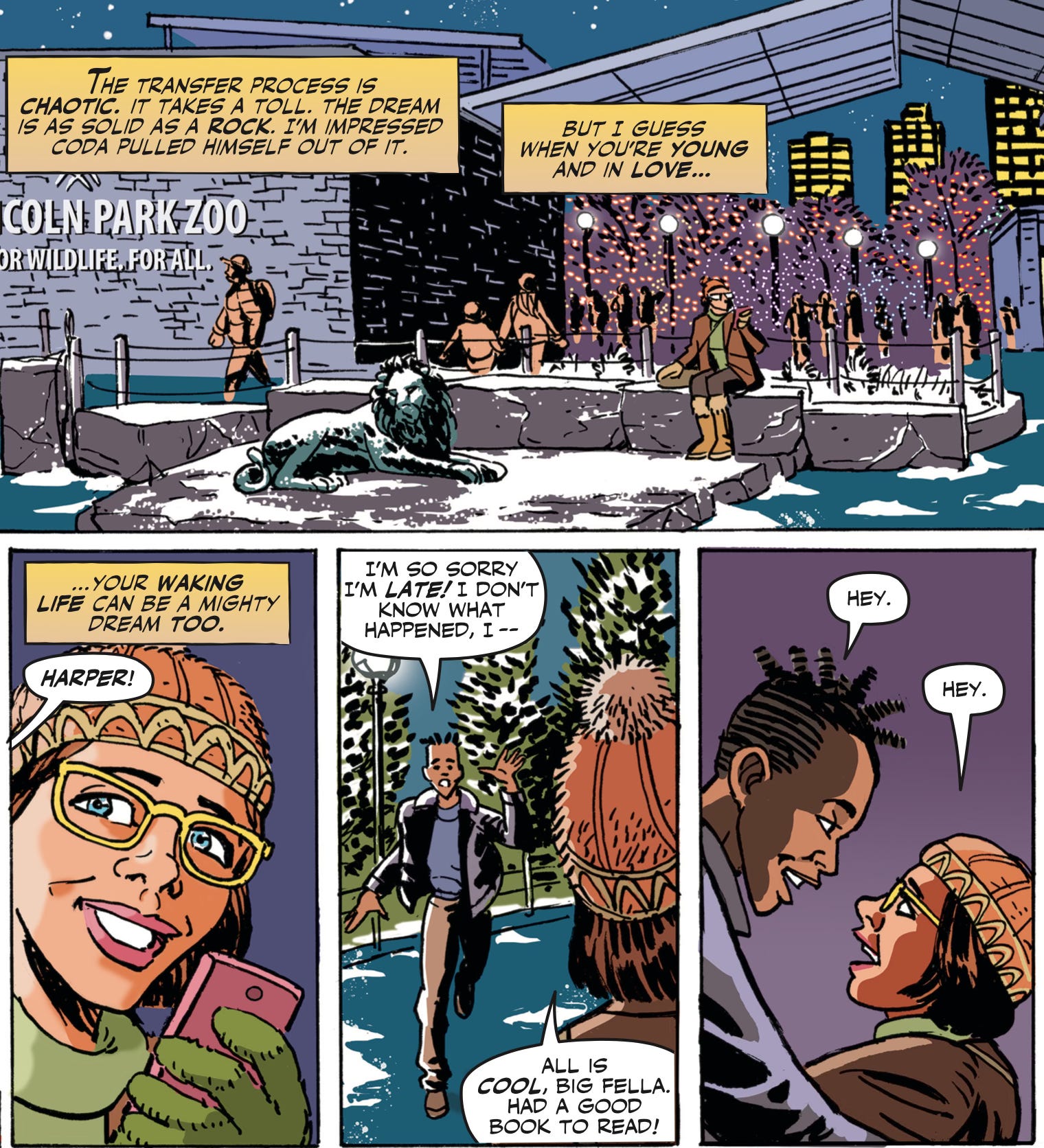
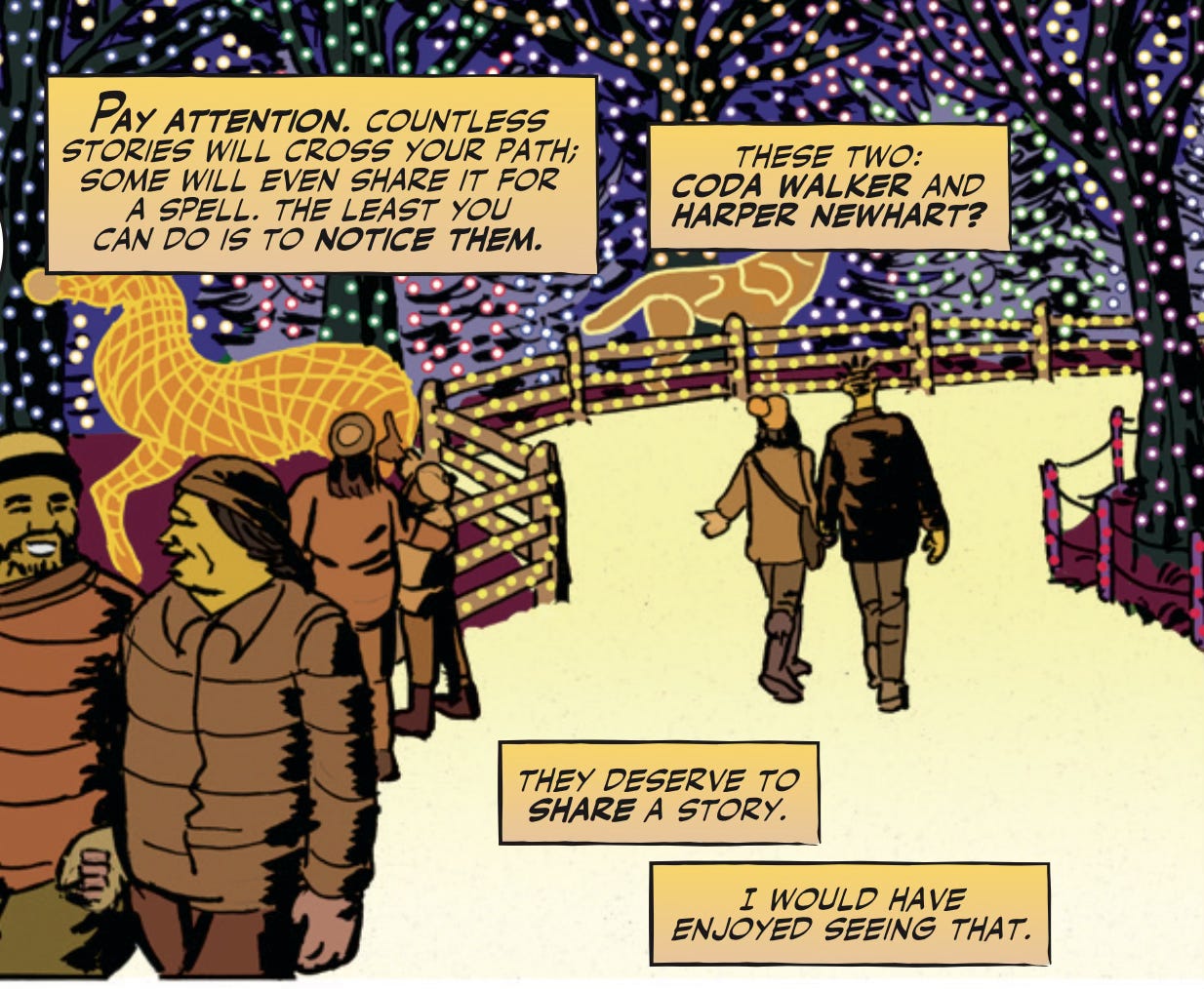
I’ll say it again: A story’s tension comes from forces conspiring against a desired outcome. We all want something, even if it’s just a moment’s peace. Characters in your story are no different, all of them. Sure this might seem obvious. But as an exercise, for each character in your story, ask the question ‘what do they want?’ and more than this, ‘what, exactly, is standing in their way?’
Apply this to each chapter or story beat, not just the character’s journeys as a whole. Then consider some hard truths. Like: are there any sections in which your main character(s) has gotten what they want? If so, you might need to introduce some unrequited needs into those sections. Then repeat this exercise for every character in your tale, however minor.
Often, when conducting this exercise we’ll find a character or two whose existence is utterly without its own tension. Most often, these are characters who exist purely for exposition. This isn’t just awkward. No. It’s far worse than that. This can make things boring! Give them some of their autonomy back by injecting some of their desire and struggle into the mix. They’ll become more fleshed out and interesting as a result, and so will your story.
To be clear, injecting some drama into all of your characters doesn’t always require cumbersome backstory, nor should it distract from your core narrative’s thrust. Here’s an example from a fictional romcom:
Let’s picture one of this romcom’s main leads standing in line at a coffee shop with their buddy. This token ‘buddy’ can be more than just a confidant dolling out relationship advice, they can also be starving for that last pastry that the guest directly in front of them just purchased. As they doll out whatever exposition they have on offer, their hunger and subsequent frustration also gives us a little bit of drama for the moment at hand, a little mini tragedy we can feel. Make it a recurring bit (that they never get their ‘snack’) and you’ve got yourself some com to peanut-butter-jelly-time with that rom. This hungry-bud might not become a character for the ages, but we can all relate to being hungry. This hint of their dramatic tension draws us in to the present moment just a bit more, and serves to make the exposition dump more engaging; it adds some extra spice to the broader narrative.
Too subtle?
How ‘bout this. My favorite (not-at-all-subtle) example for this bit of storytelling advice is personified by Mr. Wilie E Coyote. You know the guy?
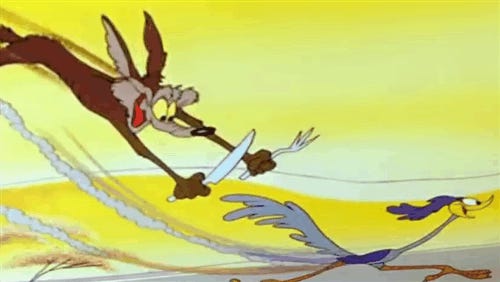
This poor dude… I’m not sure if I’ve ever felt more deeply for a fictional character. Wilie (we’re on a first name basis) just wants to eat that dang Road Runner. He wants it so bad. But absurd obstacles stand in his way, including the dependably poor craftsmanship over at Acme Corp.
We’d all be thrilled for Wilie if he ever had a moment’s satisfaction. But this would also kill the thrust of this entire storytelling world, which were, in fact, quite rigidly defined and adhered to by creator Chuck Jones (link). Like a fine tuned machine, these Looney Tune shorts are a master class in needs never getting met. Period. Meanwhile, that dang bird is the ultimate villain in large part because he always gets his meal. Only a villain gets what they want, and the Road Runner? The ultimate baddie.
The dance between Wilie’s clearly presented ‘wants’ and how they’re continuously unmet is a perfectly distilled example of this test concisely applied. Cut the check.
2. Put your characters atop a moving vehicle.
Hit the gas.
Then, even as they’re struggling to keep their balance, have folks throw rocks at them.
I don’t remember where I first heard this analogy, but I love it!
More specifically, this exercise is to picture your core characters as atop a moving train. It’s moving fast and they’re not so much ‘passengers’ on the ride ahead so much as prisoners to a fast-moving situation in which they have to hold on as best they can. But adding some fuel to this fire, our characters aren’t just stuck on this ride. Nope. There are folks along the tracks (or situations manifest as ‘folks’ for the purpose of this analogy) who are trying to knock them off.
Think of the ‘rocks’ here as x-factors. We know, or will come to know, who our antogonists might be. We’re looking for them to throw a rock. But where is the unexpected conflict? Where are the new dangers?
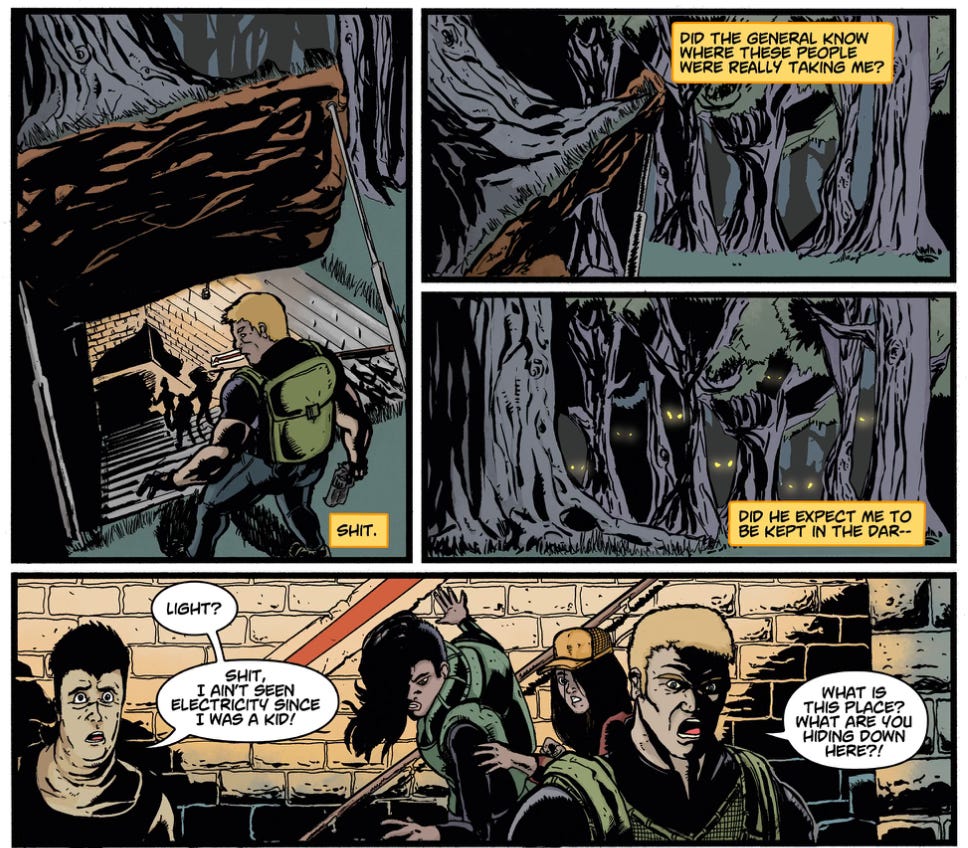
This test is closely aligned with the first one. But it’s a great accompaniment to remind us to keep a large pile of rocks handy, and how we can use them to keep our stories moving.
Holding up our stories against this analogy serves to highlight potential problems, such as:
When is nobody atop the vehicle? Perhaps there’s a point at which some of our characters are just shooting the breeze and feeling great. Maybe we have multiple pages of fun, carefree dialogue at a diner. In rare cases, a story can support such moments mid-journey, even prolonged ones. But this is rare indeed, especially in a story told as a comic.
Moving back into our analogy, a respite at a train stop can have its place. But keep it brief, introduce a rock when they least expect it. A rock such as a minor betrayal from a friend, or a thunderstorm to further exacerbate a traverse that would be dangerous on the clearest of days, or a new stakes-elevating revelation just as they are feeling some safety by the fire…
Where’s the next rock going to come from? Chuck it. Force them to move. ‘Quick. Back atop the train!!’
Keep a good pile of rocks on hand, and keep those fastballs comin’.
Okay, last one…
3. Start your story as late as possible.
This one is also true for any storytelling, but it’s that much MORE vital for comics, where we need to get to what’s visually interesting stat. In Big Shoulders one of our characters (Coda) is approached by an immortal and given a mission that holds the weight of the ages. Rather than watching Coda get ready for bed, brush his teeth and read a book before dozing off, we cut right to this fateful meeting.
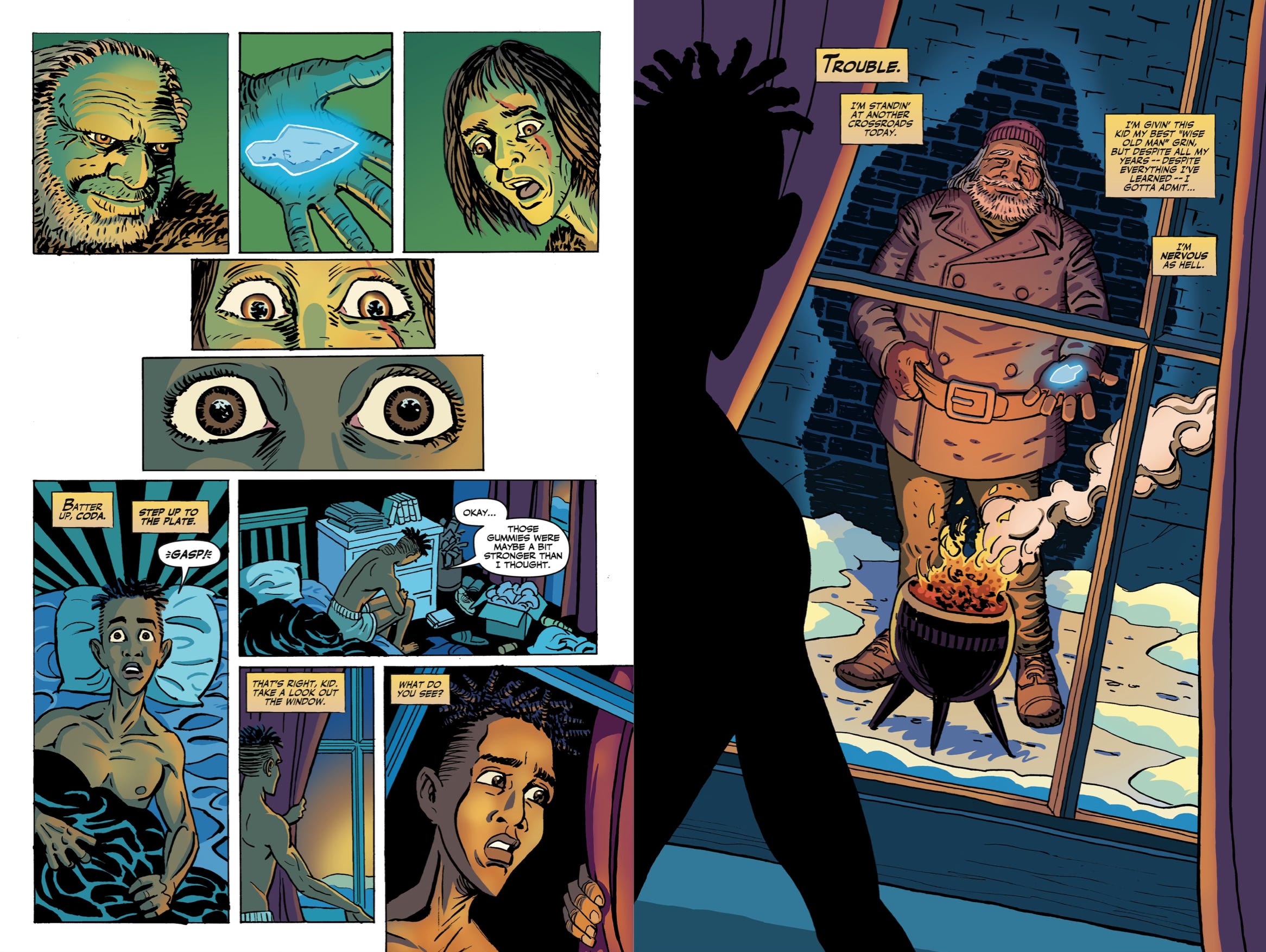
If we’re spending pages and pages sitting down talking at a table, a comic isn’t taking advantage of the medium. That is, unless the artist is a master cartoonist who can really find something distinct to ensure the proceedings remain visually interesting. It’s doable. But it’s creating additional hurdles for your story.
Best to bring us into the scene right as it’s becoming actually interesting.
Then apply this test not just to where your story begins, but where each new scene begins. One place I’ve stumbled here is in assuming that I should begin each new scene at a point at which the action is right around the corner. This doesn’t necessarily need to be so. Instead, circle back to our first test, and consider where exactly each new scene could present us with that conflict between a character’s wants and that which stands in their way.
That’s the spot. Bring us back into the heat of your characters wanting something, and show us how the story’s circumstance(s) deny it for them. Each new scene should bring us directly into some form of that tension.
Just some things to keep in mind as you’re…
Until next week…
Fishing hard, or hardly fishing?